

As artificial intelligence continues its rapid integration into everything from healthcare and finance to hiring and law enforcement, a critical question has emerged: who ensures AI plays by the rules?
Organizations are under growing pressure to ensure their AI systems are not only effective, but also transparent and accountable. Governments, standards bodies, and international coalitions have started responding with a surge of frameworks and regulations aimed at governing AI. The result is a rapidly changing AI compliance landscape organizations must navigate carefully to avoid reputational, legal, and operational risks.
Why AI Needs Its Own Compliance Standards
AI is not just another IT system, it’s a dynamic, evolving decision-making mechanism that can impact people’s lives, from determining creditworthiness to influencing hiring decisions and medical diagnoses. Unlike traditional IT systems, which tend to follow static, rule-based logic and produce predictable outcomes, AI systems often learn from data and adapt over time. This adaptability, while powerful, introduces complexity, opacity, and unpredictability. These are risks that traditional compliance frameworks weren’t designed to address. As a result, new approaches are needed to ensure these systems remain transparent, fair, and accountable throughout their lifecycle.
Some of AI’s unique challenges include:
- Algorithmic Bias: AI systems can unintentionally learn and replicate patterns of bias when trained on incomplete, imbalanced, or historically skewed datasets. This can result in unfair or inconsistent outcomes in critical domains such as hiring, credit scoring, or criminal justice. Without proper oversight and validation, these biases may go undetected, leading to systemic errors and decision-making that lacks fairness, reliability, or accountability.
- Opaqueness of AI Models: Many advanced AI systems, particularly deep learning models, function as “black boxes,” making it difficult even for their developers to fully understand how decisions are made. This lack of transparency complicates efforts to audit, explain, or justify outcomes to users, regulators, or impacted individuals, raising serious concerns about accountability.
- Model Drift: Over time, AI models may begin to behave differently than when originally deployed due to new or shifting input data. This can lead to reduced accuracy or unintended consequences, which can be dangerous in high-stakes applications like healthcare, autonomous vehicles, or fraud detection. Ongoing monitoring is essential to detect and respond to these changes.
These risks aren’t hypothetical. In 2018, Amazon scrapped an AI recruiting tool after it was found to downgrade resumes from specific demographics. In 2020, a UK government algorithm for determining student grades during the COVID-19 pandemic sparked public outrage for unfairly penalizing disadvantaged students.
AI compliance standards aim to mitigate these risks, not only to meet regulatory expectations but to preserve trust and protect human rights in an increasingly automated world.
Overview of Leading AI Compliance Standards and Frameworks
- EU AI Act
The European Union’s AI Act, finalized in 2024 and now partially in effect is the world’s first comprehensive regulation for artificial intelligence. It introduces a risk-based approach, classifying AI systems into four categories:
- Unacceptable risk (e.g., social scoring): Considered inherently dangerous and are banned outright.
- High risk (e.g., biometric ID, critical infrastructure, hiring algorithms): Operate in sensitive domains and are subject to strict requirements.
- Limited risk: These are not inherently harmful but must meet transparency obligations.
- Minimal risk: Systems with negligible impact, free to operate with minimal oversight.
High-risk AI systems must undergo conformity assessments, implement risk management systems, and maintain technical documentation for audit purposes. Fines for non-compliance can reach €35 million or 7% of global turnover.
- NIST AI Risk Management Framework (AI RMF)
The U.S. National Institute of Standards and Technology (NIST) published its AI Risk Management Framework in 2023 as a voluntary tool to promote trustworthy and responsible AI. It provides a lifecycle approach to managing AI risks through four key functions:
- Map: understand AI use cases and context
- Measure: assess risk likelihood and impact
- Manage: implement controls and governance
- Govern: establish policies, accountability, and oversight
NIST emphasizes transparency, bias mitigation, and robust documentation across the development lifecycle.
- ISO/IEC 42001
Released in December 2023, ISO/IEC 42001 is the first globally recognized certifiable standard for AI management systems. It establishes a framework similar to ISO 27001 (information security) but tailored for AI, including requirements for:
- Risk assessment and mitigation
- Stakeholder transparency
- Continual improvement
- Ethical impact evaluations
Organizations can become certified against this standard, signaling a strong commitment to trustworthy AI.
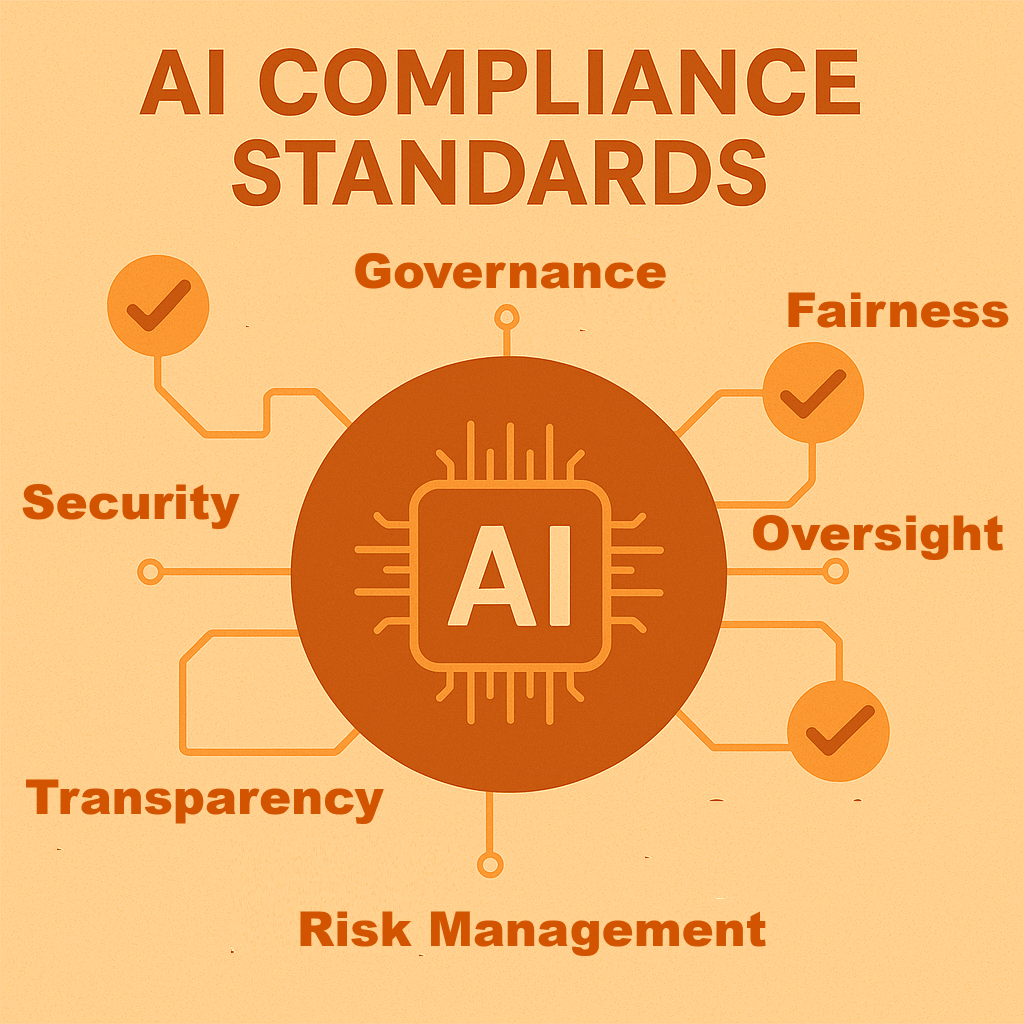
Key Compliance Themes in Modern AI Standards
Across these standards, several common themes emerge:
- Transparency & Explainability
Users and regulators must understand how decisions are made. This includes using interpretable models where possible and documenting inputs, outputs, and logic.
- Fairness & Bias Mitigation
AI must be designed and tested to prevent discrimination based on race, gender, or other protected attributes. Techniques include de-biasing datasets, fairness metrics, and adversarial testing.
- Data Governance
Proper data lineage, consent tracking, and dataset versioning are essential for traceability and trust.
- Human Oversight
Most frameworks mandate that AI decisions impacting rights or livelihoods must remain subject to human review.
- Security & Resilience
From adversarial attacks to data poisoning, AI systems must be hardened and monitored continuously.
- Lifecycle Risk Management
AI compliance isn’t a one-time audit. It involves ongoing assessment and adaptation throughout development, deployment, and post-production use.
Practical Steps for Building an AI Compliance Program
AI compliance can feel overwhelming, but many organizations begin with these foundational steps:
- Inventory AI Use
Create and maintain a list of all AI/ML systems in use, including vendors, purposes, and access levels. - Classify Risk Levels
Use frameworks like the ISO/IEC 42001 or internal criteria to assess potential harm or regulatory exposure. - Conduct Risk & Impact Assessments
Tools like Algorithmic Impact Assessments (AIA) and Data Protection Impact Assessments (DPIA) help identify and document risks early. - Establish Governance Teams
Create cross-functional working groups across legal, IT, data science, and compliance. - Integrate Compliance into the AI Lifecycle
Embed checks into each phase: from design and training to deployment and monitoring. - Adopt Tools & Artifacts
Use emerging best practices like:- Model Cards – describe model behavior, risks, and limitations.
- Datasheets for Datasets – provide dataset context and composition.
- AI Red Teaming – simulate misuse or attack scenarios.
- Maintain Audit Logs & Documentation
Keep records of decisions, data usage, model changes, and validation processes.
Conclusion
AI is reshaping the way businesses operate, but with that ability comes the responsibility to ensure it’s done ethically, transparently, and safely. Compliance standards, from the EU AI Act and ISO 42001 to NIST’s AI RMF, are setting the foundation for responsible AI governance.
The time to act is now. Organizations that embed AI compliance into their operational DNA will not only avoid penalties, but they’ll also build more resilient, trustworthy systems and earn long-term stakeholder confidence.
Recent Comments